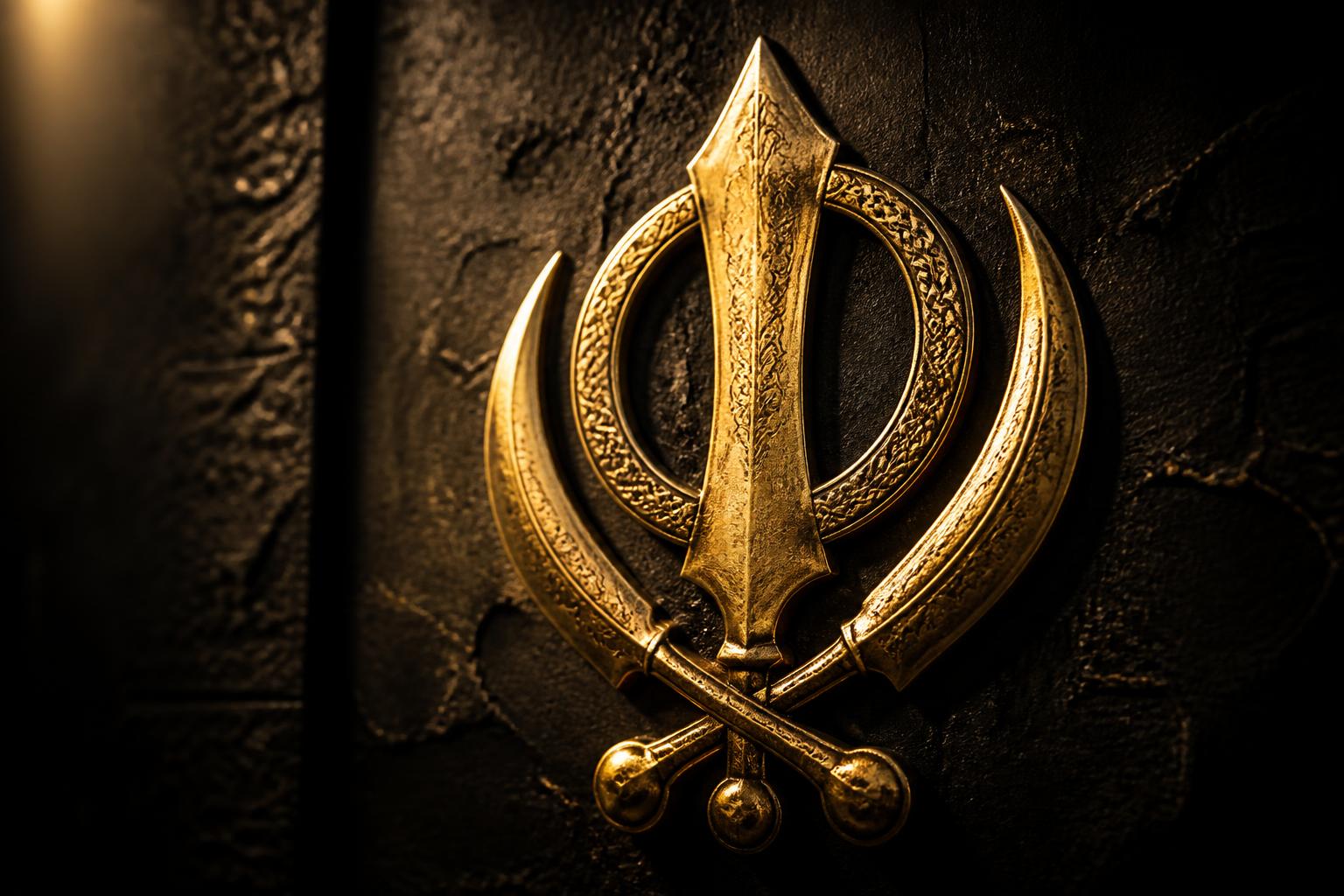
The Central Khanda — Divine Truth
At the centre is the khanda itself — a double-edged sword. One edge represents divine justice, the other freedom and authority. Together they cut through injustice on both sides.
The Two Kirpans — Miri and Piri
Flanking the sword are two curved kirpans, introduced by the sixth Guru, Guru Hargobind. They stand for Miri and Piri — temporal power and spiritual authority. A Sikh is called to hold both: strength in the world, and depth within it.
The Chakkar — The Eternal Circle
The steel ring is the chakkar — infinite, without beginning or end. It represents the one eternal God, and reminds the wearer that all creation is bound in oneness.
Wearing the Khanda
The Khanda is sacred. When it appears on clothing, it should be carried with awareness — not slapped on for aesthetics. Our Rūh Azaad tee places the Khanda in gold, on the back, at the centre of the shoulder blades: the posture of someone walking with the emblem, not selling it.
Frequently Asked
- What is the Khanda a symbol of?
- The Khanda is the emblem of the Khalsa and represents divine truth, the balance of spiritual and temporal power (Miri-Piri), and the oneness of God.
- Is it okay to wear the Khanda on clothing?
- Yes, when done with respect. Avoid placing it on lower garments or in contexts that trivialise its meaning.