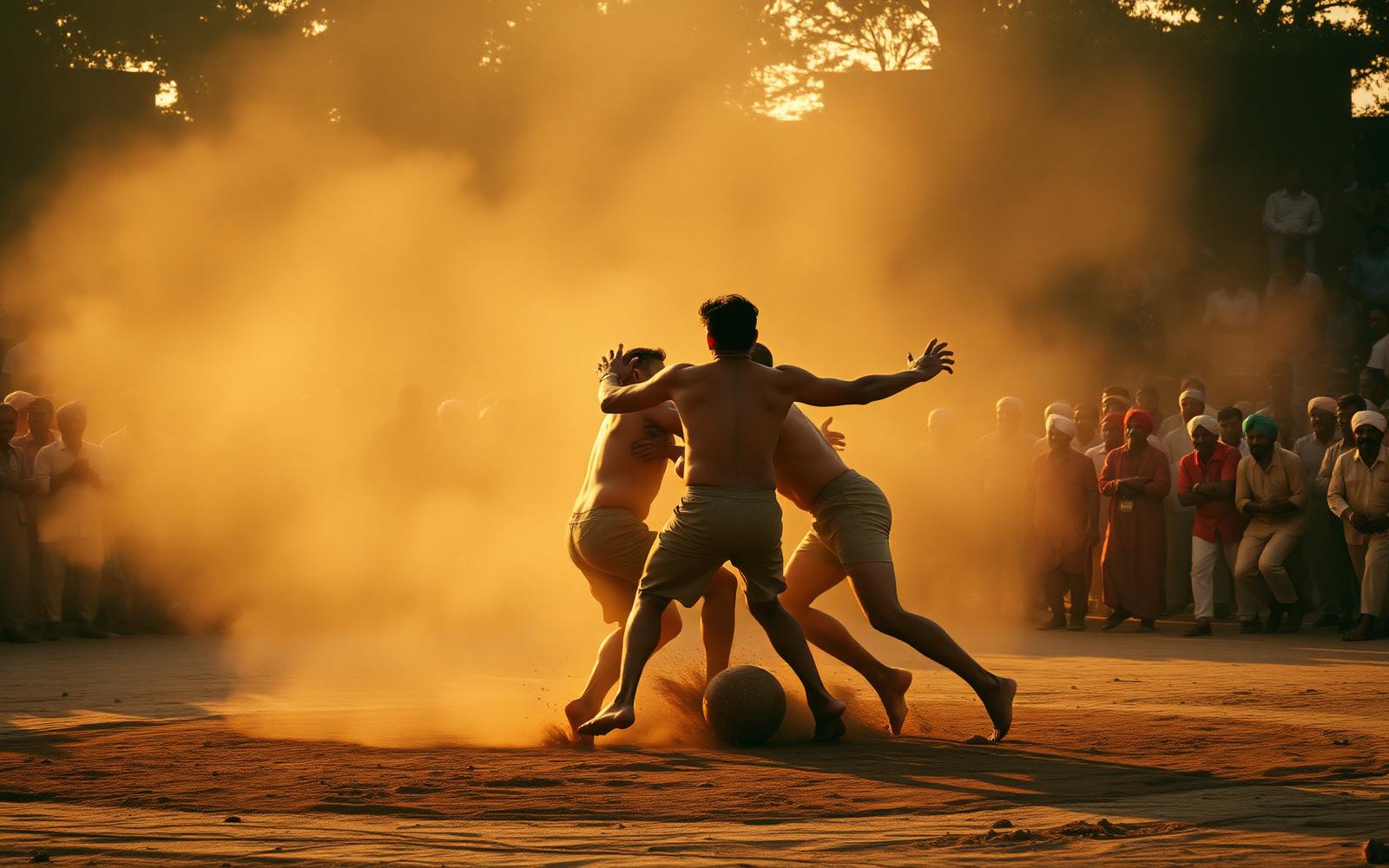
Circle Kabaddi — Punjab's Own Version
The kabaddi most of the world sees on television is standard style: rectangular mat, seven a side, Pro Kabaddi League. Punjab plays circle style. A raider crosses into a circular field, touches a defender — the jaffi — and tries to get back across the line without being held.
There are no lobbies and no crowded chains of defenders. It is one raider against one stopper, in the open, with the village watching. That is why Punjabi kabaddi looks less like a team sport and more like a series of duels.
The Akhara and the Body It Built
Training happened in akharas — earth-floor pits where wrestlers and raiders worked before dawn. Diet was almonds, milk, ghee and desi khurak. Strength was built through mitti, not machines.
That physical culture is inseparable from the imagery Punjab uses for itself: the Sher, the wrestler's frame, the horse. The kabaddi player is the everyday version of the warrior symbol we print.
Harvest Tournaments and the Diaspora Circuit
Village tournaments cluster after harvest, when the fields are clear and money is in hand. A single day can run twenty matches with a loudspeaker commentator, a dhol, and a tractor parked as the grandstand.
The diaspora rebuilt the circuit abroad. Summer kabaddi cups in Surrey, Southall, Melbourne and Yuba City draw thousands, and teams travel between them. For second-generation Punjabis, a kabaddi ground is often the most Punjabi place in the city.
Why the Kabaddi T-Shirt Means Something
Club shirts at these tournaments are printed in tiny runs — village name, sponsor from the local dhaba or trucking firm, a lion or a Khanda. They are not fashion, which is exactly why they read as authentic. Wearing one says you were there.
That is the same instinct BAAG designs from: heavyweight cotton, one symbol, no explanation. Our tees are not kabaddi jerseys, but the Sher and Khanda graphics come out of the same well of imagery — strength held with restraint.
Watching Your First Match
Follow the raider, not the ball — there is none. Listen for the crowd's noise to change: a clean escape and a successful jaffi sound completely different. Matches move in short bursts, so a full tournament is easy to watch even without knowing the rules.
If you want the wider context, read our history of Punjab culture and the guide to Punjab's regions — the kabaddi map and the cultural map are almost the same map.
Frequently Asked
- What is circle kabaddi?
- Circle kabaddi is Punjab's traditional version of the sport, played in a circular field where a single raider faces a single defender, rather than the rectangular seven-a-side standard style seen in the Pro Kabaddi League.
- Why are kabaddi t-shirts popular among Punjabis?
- Club shirts from village and diaspora tournaments are printed in tiny runs with a village name and local sponsor. Wearing one signals belonging to a specific place and circuit, which is why they read as identity rather than merch.
- Where is kabaddi played outside India?
- Punjabi diaspora tournaments run every summer in Canada, the UK, Australia and the United States — Surrey, Southall, Melbourne and Yuba City host some of the largest.