Phulkari — Flower Work, Literally
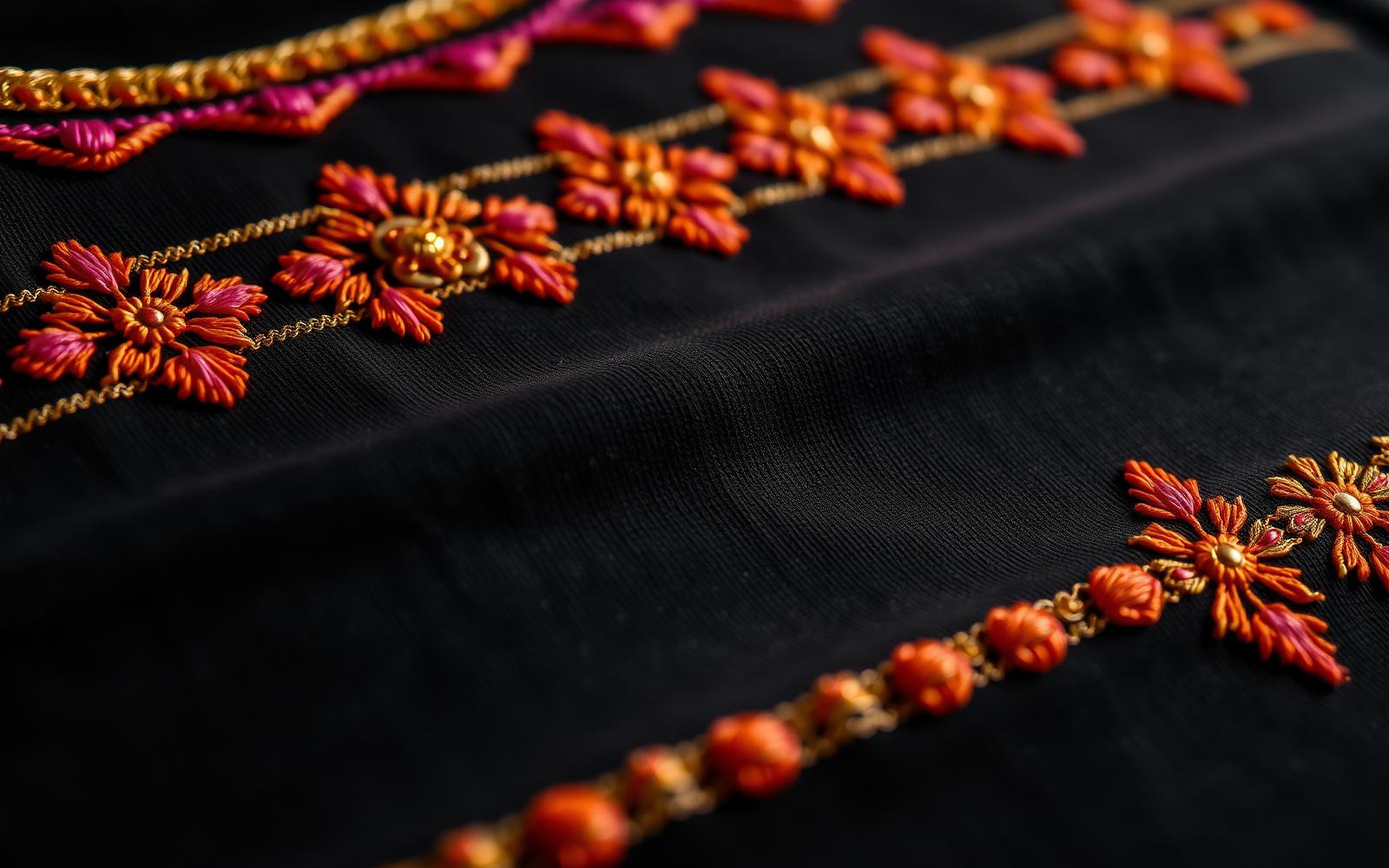
Phulkari is the folk embroidery of Punjab: untwisted silk floss, called pat, worked in darning stitch onto handspun khaddar. The stitch is worked from the reverse, which is why the front reads as dense, luminous colour with almost no visible outline.
Bagh — garden — is the most demanding form, where the embroidery covers the base cloth entirely. A bagh took months and was begun at a girl's birth to be worn at her wedding. Chope, sainchi and vari-da-bagh each carried their own occasion and grammar.
Why Phulkari Suits a T-Shirt
Phulkari is built from geometry — repeating diamonds, chevrons, wheat forms, stylised florals arranged in fields rather than scenes. Geometric repetition scales beautifully across a wide chest panel, which is exactly the canvas an oversized tee gives you.
It is also colour-led rather than line-led. On a 280 GSM garment-dyed body, a phulkari field reads as a block of controlled colour from across a room, and resolves into stitch structure up close. Lighter blanks cannot carry that weight of pattern without buckling.
Embroidered vs Printed — What You Are Actually Buying
True embroidery adds thread to cloth: it has physical relief, catches light, and survives washing better than any ink. It is also slow, heavy on dense fields, and expensive — a full bagh-style panel on a tee is not a mass-market product.
High-quality print reproduces the motif grammar flat, keeps the garment light and drapey, and lets the artwork run larger. BAAG uses print for full-field phulkari graphics and reserves embroidery for smaller placements where relief adds something — a chest crest, a sleeve mark, a hem signature.
Neither is more authentic. What matters is whether the motif has been understood or simply lifted.
Reading a Phulkari Motif
The diamond field is the base grammar — an abstraction of a flower head repeated until it becomes a garden. Chevrons mark direction and movement, often read as wheat or water. Border bands close the composition, which is why traditional pieces never bleed off the edge without a frame.
Colour carried meaning too: golden-yellow and crimson for celebration, white for mourning pieces in some districts. We keep the palette restricted to gold, cream and forest so the geometry stays the subject.
Caring for an Embroidered T-Shirt
Wash cold at 30°C, inside out, on a gentle cycle. Embroidery threads and printed fields both fail first from friction, and turning the garment inside out removes almost all of it.
Skip fabric softener, skip bleach, line dry in shade. Iron on low from the reverse only — never directly onto stitching or print. Store folded; heavy cotton on a thin hanger develops shoulder points.
Shop the Phulkari Work
The phulkari graphics page collects the pieces built on this vocabulary, and the Punjabi t-shirts collection carries the wider range in the same 280 GSM cotton.
Frequently Asked
- What is a phulkari embroidered t-shirt?
- A t-shirt carrying phulkari — Punjab's traditional silk-floss folk embroidery — either as real thread work or as artwork that follows phulkari's geometric motif grammar on heavyweight cotton.
- Is embroidery better than print on a t-shirt?
- Embroidery adds relief and lasts extremely well but is heavy and costly on large fields. High-quality print carries full-field artwork better. BAAG uses print for large phulkari fields and embroidery for smaller placements.
- How do I wash an embroidered t-shirt?
- Cold wash at 30°C, inside out, gentle cycle, no softener or bleach, line dry in shade, and iron on low from the reverse only.